
The AI Ethics Brief #191: The Terms of the Bargain
What we give up, who gets to refuse, and the road to SAIER Volume 8 (2026).

Welcome to The AI Ethics Brief, a bi-weekly publication by the Montreal AI Ethics Institute. We publish every other Tuesday at 10 AM ET. Follow MAIEI on Bluesky and LinkedIn.
📌 Editor’s Note
In this Edition (TL;DR)
What Power Asks Us to Give Up: A Wadham Thinking Deeply conversation on agentic AI, autonomy, and the questions shaping SAIER Volume 8 (2026).
The Architecture of Refusal: A look at the mounting economics of enterprise AI adoption, institutional refusals from newsrooms to public procurement, Pope Leo XIV’s first encyclical on AI and human dignity, and a public mood the inevitability narrative wasn’t built to absorb.
Tech Futures — The AI Resist List: With RAIN, we look at a new global resource mapping resistance to AI inevitability across narratives, funding, data, labour, surveillance, adoption, and policy.
AI Policy Corner — Australia’s National AI Plan: With GRAIL at Purdue, we examine Australia’s decision to shelve proposed mandatory AI guardrails in favour of a competitiveness-focused national strategy built on voluntary guidance.
What Connects These Stories:
Every AI promise asks for something in return. Delegation costs agency. Smoother search costs visibility. Experimentation-as-mandate costs labour protections. National AI plans cost public accountability.
What has changed is that more people are noticing the exchange and questioning the terms of the bargain. Workers are challenging AI in the newsroom. Public officials are questioning vendor lock-in. Students are booing AI cheerleading from their commencement seats. Researchers and communities are mapping resistance across the infrastructures that make AI feel inevitable.
Refusal is not obstruction. It is a way of asking whether the terms are acceptable before the system becomes too embedded to challenge.
That is where SAIER Volume 8 (2026) begins.

What Power Asks Us to Give Up
In Brief #173, we wrote from Wadham College, Oxford, during the Wadham Experience: Thinking Critically programme. The week was organized around questions that sit close to AI governance: democracy and demagoguery, institutional adaptation, political authority, and the stories societies tell themselves in moments of rupture.
Those conversations shaped how we were thinking about the next phase of the State of AI Ethics Report (SAIER). Not because Wadham offered a policy framework, but because it offered something AI governance often lacks: time to think historically, politically, and philosophically about what is being changed.
That kind of thinking is necessary because AI governance is never only about technical systems. It is also about the institutions that deploy them, the people affected by them, and the forms of power they make possible. The questions underneath are questions of authority, dependency, consent, power, and the conditions under which people are able to act freely.
Wadham has since launched Thinking Deeply, a public conversation series. The first event was held in March at The Ned in London, where Professor Christopher Summerfield joined Robin Clyfan for a conversation on AI, cognition, and society. Summerfield is Professor of Cognitive Neuroscience at Oxford, a founding researcher at DeepMind, and Research Director at the UK AI Security Institute.
Asked about agentic AI, systems that act on a person’s behalf with broad goals rather than specific instructions, Summerfield framed the central risk in terms of autonomy. Every technology, he suggested, asks us to give something up. Social media has already demanded our attention. Agentic AI may demand more of our agency. And the political movements of the past decade, with their repeated promise to “take back control,” suggest that many people already feel something has been taken from them.
SAIER Volume 8 returns in November 2026
That observation gives us a useful frame for the next edition of the State of AI Ethics Report.
SAIER Volume 7 (2025) focused on community-centered solutions: how people, institutions, and movements respond to AI in practice. SAIER Volume 8 (2026) turns to the conditions from which those responses are emerging: power, fracture, and resistance.
SAIER Volume 8 (2026), titled Power, Fracture, Resistance, will document what it looks like when AI systems restructure access to information, privacy, labour, governance, education, public services, and cultural life in ways that communities often had little say in designing.
AI capability is being embedded into institutions, markets, workplaces, and infrastructures before the public has had a meaningful opportunity to decide what kinds of delegation are acceptable, what forms of dependency are dangerous, and what should remain human.
When AI is framed as a productivity tool, the bargain can seem straightforward. We give up friction and receive efficiency. We give up effort and receive convenience. We give up some decisions and receive faster workflows, better recommendations, and more personalized services.
See also: When Governments Let Algorithms Decide Prices by Renjie Butalid (Tech Policy Press, May 11, 2026)
The exchange also reaches deeper. We may give up the ability to understand how decisions are made. We may give up the habit of deliberation. We may give up institutional accountability by relocating judgment into systems no one can meaningfully question. We may give up forms of work, expertise, and social connection that are difficult to measure precisely because they are human.
The risk is ordinariness: a system of delegation so useful, ambient, and deeply integrated that its terms become invisible.
That is the terrain SAIER Volume 8 (2026) will map.
SAIER has always been more than a report. Since the first edition in 2020, it has tried to serve as a historical record: a snapshot of where we actually stood on AI, not where the press releases said we did. The early editions appeared at an uneven pace, reflecting both the urgency of the moment and the ambition of the project.
After a pause, SAIER returned in November 2025 with Volume 7. With SAIER Volume 8 (2026), it becomes an annual publication: a yearly account of the fault lines that have opened or widened, and of what practitioners, researchers, advocates, policymakers, and communities can do about them.
SAIER Volume 8 (2026) continues that work at a moment when the stakes are higher and the fractures are deeper. We are living through the consolidation of AI power, the weakening of governance frameworks, and the emergence of new forms of resistance from workers, artists, educators, communities, civil society organizations, and public institutions.
That resistance matters because the future of AI is still open. The question is what we want from technology, and what we are prepared to give up in return. It needs to be asked before the terms of the bargain are set for us.
This is the work now: to document what is being given up, to name who is being asked to give it up, and to ask what forms of power, accountability, and resistance might still shape what comes next.
The conversation Thinking Deeply in the Age of AI with Professor Christopher Summerfield is available on YouTube.
SAIER Volume 8 (2026) is now open for contributions. Read the proposed outline, explore the themes, and submit an expression of interest.
The Architecture of Refusal
Three themes have emerged in the two weeks since our last edition.
The first is intermediation: AI systems moving between people and the web, the workplace, and public institutions. The second is the economics of AI adoption, and how quickly the numbers are becoming impossible to ignore. The third is refusal: specific, institutional, and increasingly successful. Together, they point to a public mood that the industry’s inevitability narrative was not built to absorb.
At Google I/O, the company announced what it called “a new era for AI Search”: agents that monitor the web on a user’s behalf, synthesize updates across blogs, news sites, and real-time data, and generate custom interfaces on the fly. Google is building an abstraction layer that it owns and moderates. In that model, websites, writers, and publishers matter less as destinations than as raw material.
That shift matters because it changes not only how people find information but what kind of web remains available to be found: a web people passively receive rather than one they navigate.
The web was never just a collection of pages. It was a structure of links, sources, contexts, and choices. When AI systems summarize that web from above, the experience becomes smoother and the context becomes narrower. Someone else decides what is worth seeing. When you cannot see the source, you cannot question the answer.
The same pattern is becoming visible inside workplaces, where AI is not only changing how information is accessed, but how work itself is measured, justified, and paid for.
There, the economics are becoming harder to ignore. For companies buying AI tools, the costs are already outpacing the promised returns. Microsoft reversed course on Claude Code licenses this month after enterprise token costs outpaced any measurable return. For the hyperscalers building the infrastructure beneath those tools, the numbers are even larger. Ed Zitron’s accounting this past week was blunt: Microsoft and its fellow hyperscalers have invested hundreds of billions into AI infrastructure with no clear path to recovering it, and the cost of running large models does not shrink with use. In many cases, it grows.
Workers, meanwhile, are being pressured to adopt AI as rapidly as possible, with token budgets burned through before anyone can say what the tools save or what they make worse. Uber, for example, exhausted its 2026 AI coding tools budget within four months after encouraging internal adoption through leaderboards that ranked teams by AI tool usage.
The metric becomes adoption itself. Experimentation becomes the cover. Under those conditions, refusal has to move from individual discomfort into formal power: contracts, procedures, procurement rules, and labour agreements.
That is what makes some of this week’s refusals notable. They are not symbolic. They are contractual, procedural, and enforceable.
The Washington-Baltimore News Guild announced that POLITICO agreed to permanently shut down two AI tools at the centre of a landmark labour arbitration: Capitol AI Report-Builder, which produced branded policy reports without editorial review, and Live Summaries, which generated unedited coverage of major political events, including the 2024 Democratic National Convention and Vice Presidential Debate. Both produced serious factual errors. The arbitrator found POLITICO had violated its collective bargaining agreement. The PEN Guild’s chair put it plainly: “These tools do not belong in our newsroom.”
In London, Mayor Sadiq Khan blocked a proposed £50 million Metropolitan Police deal with Palantir. His office cited a clear breach of procurement rules: Scotland Yard had engaged seriously with only one potential supplier, had not demonstrated value for money, and had risked locking a public institution into a single vendor’s infrastructure indefinitely.
These are different contexts and different stakes: one about editorial labour and the integrity of newsroom work, the other about policing, procurement, and public infrastructure. But both ask the same question before the system becomes embedded: is this actually acceptable?
These cases are not isolated. They are part of a wider pattern that is becoming easier to see: refusal moving across workplaces, public institutions, infrastructure fights, policy debates, and cultural life.
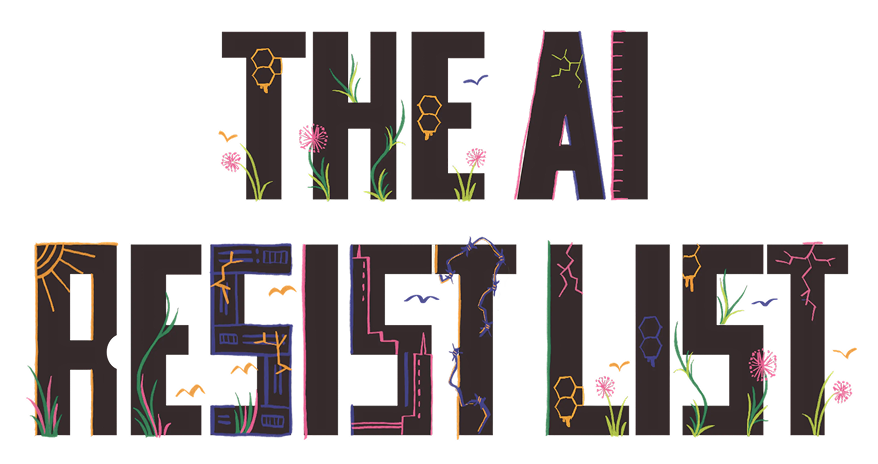
This is why this edition’s Tech Futures piece matters. The AI Resist List, launched earlier this month by Karen Hao, DAIR, We and AI, the Refugee Law Lab, and collaborators, maps resistance across nine pillars: narratives, funding, data, resource extraction, data centres, labour, adoption, surveillance, and policy. It shows that refusal is no longer just reactive. It is becoming organized, documented, and shared.
If the POLITICO and Palantir cases show refusal becoming institutional, the reaction to this year’s commencement speeches shows it becoming cultural.
Clips of students booing AI references at multiple U.S. graduations spread widely across social media before being picked up in national coverage. In one NPR segment, graduates connected the backlash to concerns about jobs, environmental costs, and whether AI is being shaped by institutions that represent their interests.
The kids are alright.
And they are not alone. What is striking is how far this mood has travelled beyond the usual circle of critics. Camilla Cavendish is not a natural techno-skeptic. Writing in the FT this week, she argues that a backlash is coming when AI’s benefits and burdens are distributed unevenly. Standard Chartered recently announced the end of 8,000 roles, describing the people affected as “lower-value human capital.” Its CEO, Bill Winters, later apologized for his “choice of words” after the phrase drew criticism.
The apology matters, but so does the fact that the phrase was used at all. It made explicit a logic that usually stays hidden: that some workers are being understood less as people with expertise, livelihoods, and institutional memory than as costs to be replaced.
Her comparison to the Luddites is useful. The original Luddites were not opposed to machinery. They were against the conditions that machinery was being used to impose. The 21st-century version, she argues, will be the middle and working classes.
The timing is hard to miss. Pope Leo XIV’s first encyclical, Magnifica Humanitas, also takes up the question of AI and human dignity. Subtitled “On Safeguarding the Human Person in the Time of Artificial Intelligence,” it was signed on the anniversary of Rerum Novarum, Pope Leo XIII’s 1891 encyclical on the condition of the working classes during the Industrial Revolution, widely regarded as the foundational document of modern Catholic social teaching. The reference places today’s AI debate in a much longer history of arguments about technology, labour, power, and the conditions under which human beings are asked to live.
Together, these stories span search, software, journalism, policing, labour, education, and now moral authority, from newsroom arbitration and public procurement to students booing AI from their commencement seats. They point to the same underlying question: who gets control over the systems people depend on, and who is allowed to refuse?
For years, AI adoption has been narrated through inevitability (see Brief #187 and notinevitable.ai). The tools are coming. The tools are already here. The “responsible” choice is to adapt.
But the past two weeks suggest something more specific. The future is being negotiated through contracts, procurement decisions, workplace disputes, interface changes, and infrastructure investments. It can be contested there too.
Refusal is not obstruction. It is a form of governance. It asks whether the terms are acceptable before the system becomes too embedded to challenge.
AI can be useful. Usefulness can also become the language through which surrender is made to feel inevitable.
The past two weeks suggest more people are beginning to notice the bargain.
Please share your thoughts with the MAIEI community:
💭 Insights & Perspectives:
Tech Futures: Introducing the AI Resist List
This edition of our Tech Futures series, a collaboration with the Responsible Artificial Intelligence Network (RAIN), examines the growing movement challenging AI inevitability narratives and introduces the AI Resist List. Built by Karen Hao, the DAIR Institute, We and AI, the Refugee Law Lab, and collaborators, the project maps efforts around the world to resist, refuse, reclaim, and reimagine AI across areas including narratives, funding, data, labour, surveillance, adoption, and policy.
To dive deeper, read the full article here.
AI Policy Corner: From proposed mandatory guardrails to the National AI Plan: AI governance in Australia
This edition of our AI Policy Corner, produced in partnership with the Governance and Responsible AI Lab (GRAIL) at Purdue University, examines the evolution of AI governance in Australia. After proposing mandatory guardrails for high-risk AI in 2024, the Australian government shifted course with its 2025 National AI Plan, prioritising competitiveness, adoption, and voluntary guidance over enforceable AI-specific obligations. The piece asks what this pivot means for safety, accountability, and the balance between innovation and public protection.
To dive deeper, read the full article here.
❤️ Support Our Work

Help us keep The AI Ethics Brief free and accessible for everyone by becoming a paid subscriber on Substack or making a donation at montrealethics.ai/donate. Your support sustains our mission of democratizing AI ethics literacy and honours Abhishek Gupta’s legacy.
For corporate partnerships or larger contributions, please contact us at support@montrealethics.ai
✅ Take Action:
Have an article, research paper, or news item we should feature? Leave us a comment below — we’d love to hear from you!