
The AI Ethics Brief #192: Canada Has a National AI Strategy. The Hard Questions Come Next.
On Adoption, Sovereignty, and the Questions the Strategy Leaves for Later.


Welcome to The AI Ethics Brief, a bi-weekly publication by the Montreal AI Ethics Institute. We publish every other Tuesday at 10 AM ET. Follow MAIEI on Bluesky and LinkedIn.
📌 Editor’s Note

In this Edition (TL;DR)
Canada’s AI Strategy and What It Leaves Unsettled: Canada releases its national AI strategy with ambitious targets: 60 percent business adoption by 2034, 250,000 new jobs by 2031, and a $200 million initial investment in health outcomes. The harder questions, who governs, who benefits, and what sovereignty actually requires, are mostly left for later.
Quick Poll — Where are you feeling the pressure most this year? As we shape SAIER Vol. 8, we want to know where the pressure feels most immediate to the people working through it.
Keynote at MISSION Hubs Forum 2026: Our Director of Partnerships, Connor Wright, brings MAIEI’s approach to AI governance into the world of creative agencies, examining what happens when businesses embed AI without adequate governance, and why asking “why?” before “how?” is the difference between responsible integration and costly backtracking.
Tech Futures — At the Frontier of Fear, Uncertainty and Doubt: With RAIN, we trace the origins of “fear, uncertainty and doubt” as a Big Tech marketing strategy, from IBM in the 1970s to AI safety narratives today. The piece asks why AI companies emphasize the danger of their own products, and who benefits when they do.
Recess — Is AI in Law School a Helpful Tool or a Hidden Trap?: From Encode Canada at McGill, a look at how AI-driven hiring practices are reshaping the job market for graduates, and why the same tools that promise efficiency risk entrenching racial and gender bias at the point of entry.
What Connects These Stories:
Canada’s national AI strategy wants adoption to drive benefit. The keynote shows what happens to organizations that embed AI before asking what it is for. The Tech Futures piece asks who controls the narrative that makes adoption feel urgent. The Recess piece shows what happens to people who enter the room after the systems have already been built.
The thread running through all of it is the gap between stated intent and structural follow-through. Strategies name trust as a north star while passing legislation that undermines it. Companies adopt AI for efficiency while entrenching bias. Creative agencies chase AI integration without governance frameworks to catch them when it fails.
That gap is not incidental. It is where the real decisions get made, quietly, before the accountability mechanisms arrive. The questions this edition keeps returning to are the same ones Canada’s strategy mostly leaves for later: who benefits, who decides, who is protected, and who can refuse.
Those questions do not resolve themselves. They require the institutions, laws, and habits of accountability that strategies gesture toward but rarely build. That is the work SAIER Volume 8 (2026) is designed to map.

Canada’s AI Strategy and What It Leaves Unsettled
By Renjie Butalid, Co-Founder, Montreal AI Ethics Institute
Canada’s new national AI strategy arrives with the right vocabulary: trust, opportunity, sovereignty, AI for all. It treats AI as infrastructure, labour, industrial, education, public-sector, and democratic policy at once, which is the correct way to see it. For years, our AI story has been easiest to tell in the past tense: we helped build the field, trained the researchers, created the institutions. We produced the founders. The companies scaled elsewhere.
The present-tense question is whether Canada can turn that research strength into domestic capacity, public benefit, commercial scale, and democratic control.
The strategy is a serious attempt to answer it. It sets ambitious targets: business adoption from 12 percent today to 60 percent by 2034, 250,000 new jobs through AI by 2031, and a $200 million initial investment in health outcomes. It backs them with money for compute, skills, public-sector AI, Canadian firms, and literacy.
Its weakness is that it treats the hardest questions as implementation details. Who governs the systems Canadians are asked to trust? Who owns the value adoption creates? What happens to workers whose jobs change faster than retraining can follow? What does sovereignty mean if the compute, models, capital, and platforms stay dependent on foreign firms? These are the terms of the bargain, and the strategy mostly leaves them for later.
Take adoption, its clearest metric. A country can adopt AI quickly and grow more dependent. A firm can automate and lose expertise. A worker can become “AI literate” and still have no say over how AI reshapes their job. Adoption and benefit are not the same thing. The frame needs a public-interest test: who benefits, who bears the risk, who can contest a system, who can refuse, and who owns the resulting data and value.
Sovereignty has the same problem. The strategy is right that it depends on infrastructure: compute, cloud, data, procurement, capital, standards, domestic firms. It should mean more than subsidized access to foreign tools or a Canadian name in the procurement chain. The strategy itself acknowledges that sovereign compute capacity is nascent and that Canada currently relies on foreign providers for the infrastructure underpinning its economy and public sector.
Sovereignty by design means deciding in advance which capacities stay under Canadian control, which public datasets are governed as public assets, which procurement rules prevent lock-in, and which systems should not be adopted at all. Sovereignty is just a mood without enforceable commitments: procurement rules that prevent lock-in, data governance that keeps public assets in public hands, and capital conditions that stop Canadian IP from scaling under foreign flags. A country that trains the researchers and loses the companies has already answered the question of where the value goes.
Trust cannot be deferred either. The strategy asks Canadians to accelerate adoption now and trust that privacy laws, online-harms rules, certification, and standards are coming. That sequencing is the gap. According to the KPMG-University of Melbourne global trust study, Canada ranks 42nd out of 47 countries in trust of AI systems, and fewer than one in four Canadians report having received any AI training (See also Brief #169). Trust is not produced by telling people that protections will arrive later. It is produced when people can see the rules and know where power sits before systems are embedded in healthcare, hiring, lending, policing, and public administration.
The strategy also commits to modernizing privacy legislation and restricting the use of personal data for surveillance pricing. But as Michael Geist has noted, the government is simultaneously pressuring Parliament to pass Bill C-22, whose mandatory metadata retention regime is the single largest privacy risk in Canada in years and one that comparable countries have already struck down as a violation of the fundamental right to privacy. A right the government writes into one bill and overrides in the next is neither a true fundamental right nor the foundation of trust the strategy needs.
That tension is not unique to privacy law. The same gap between stated commitment and structural follow-through shows up wherever AI governance meets real institutional stakes.
One lesson from financial market infrastructure is useful here. In digital assets, the governance problem is speed: blockchain networks settle continuously, and risk can surface in minutes, if not seconds. AI makes oversight at that speed possible, under three conditions:
The data has to be live, auditable, verifiable and traceable to its source;
The system has to sit inside real institutional workflows, mapped to risk appetite, escalation paths, and accountability;
And a human has to own the judgment and sign the output.
That model travels. For AI in healthcare, public administration, or any high-stakes institutional setting, the test is whether the system is grounded in verifiable data, embedded in accountable workflows, and subject to human judgment where rights and public trust are at stake. Capability and adoption do not meet that test. Meeting it is what turns AI from a productivity tool into governable infrastructure.
Literacy belongs in the same frame. It is civic infrastructure, and the focus on libraries, schools, and community organizations is right, since literacy cannot be left to private platforms alone. The risk is that it shifts responsibility downward: when a system is opaque or harmful, better citizen training is not the remedy. The real test is whether literacy helps Canadians shape the systems around them or only helps them adapt to systems already chosen for them.
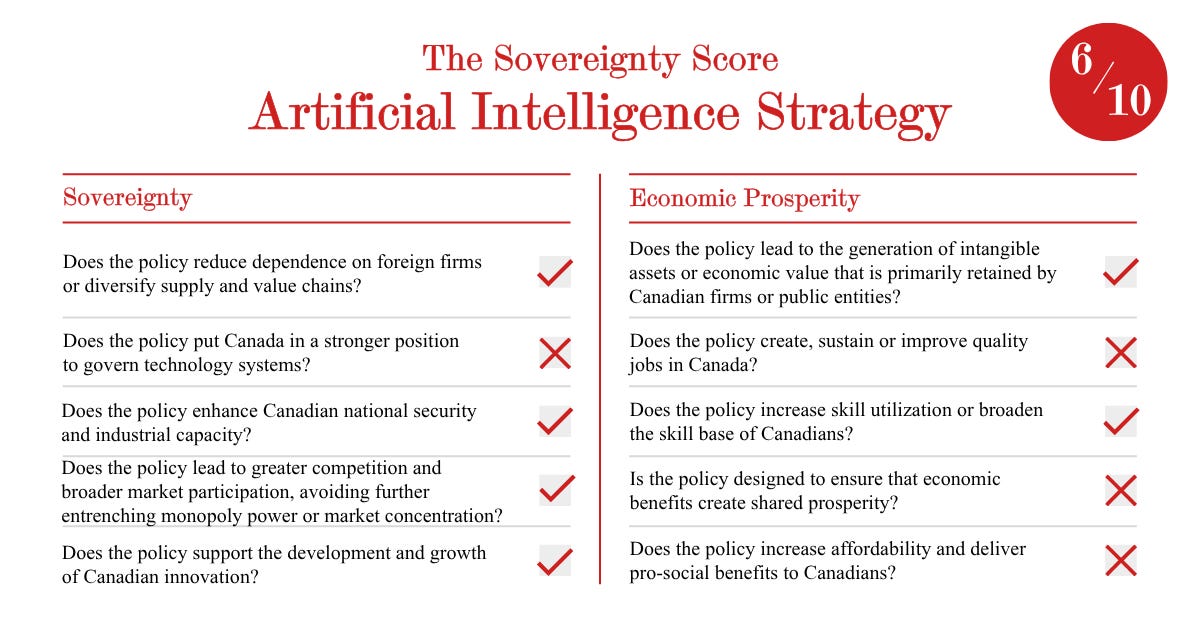
The strategy reflects Canada's own political instincts: cautious, distributive, and reluctant to choose between industrial ambition and public protection. That is not a failure. But it still has to make choices. The Canadian Shield Institute's report card on the strategy identifies where those choices remain unmade. They are not minor gaps. They are the architecture of accountability.
Canada now has the beginning of a serious AI agenda. The harder work is building the institutions, laws, and procurement systems that make it real. “AI for all” should be a test. For every investment, procurement, and deployment, the questions stay the same:
Who benefits? Who decides? Who is protected? Who can refuse? What data is the system grounded in? Who signs the judgment? And what stays in Canadian hands when the system becomes too important to walk away from?
If you are working on AI policy in Canada and are asking the same questions, reach me directly at renjie@montrealethics.ai. I’d welcome the conversation.
Please share your thoughts with the MAIEI community:
📝 From the Editor
QUICK POLL
Canada’s new national AI strategy names trust, sovereignty, and adoption as its north stars. This edition’s lead essay asks what the strategy leaves unsettled. As we shape SAIER Vol. 8, we want to know where the pressure feels most immediate to the people working through it.
SAIER Volume 8 (2026) is now open for contributions. Read the proposed outline, explore the themes, and submit an expression of interest.
💭 Insights & Perspectives:
Keynote at MISSION Hubs Forum2026: How does AI impact Creative Agency work? Avoiding Goodhart’s Law
Our Director of Partnerships, Connor Wright, was invited to keynote at the MISSION Hubs Forum2026 in Montreal, bringing MAIEI’s approach to AI governance into the world of creative agencies. The talk examines what happens when businesses embed AI without adequate governance, and why asking “why?” before “how?” is the difference between responsible integration and costly backtracking.
To dive deeper, read the full article here.
Tech Futures: At the Frontier of Fear, Uncertainty and Doubt
This edition of our Tech Futures series, a collaboration with the Responsible Artificial Intelligence Network (RAIN), distils a common narrative from AI executives: that AI is dangerous. Why would one say that about the products they sell? As it turns out, it's a strategy that was named in the 1970s and helps keep regulators at bay, granting Big Tech companies more control over the future of tech.
To dive deeper, read the full article here.
Recess: Is AI in Law School a Helpful Tool or a Hidden Trap?
This piece is part of our Recess series, featuring university students from Encode’s Canadian chapter at McGill University. It examines how AI-driven hiring practices are reshaping the job market for graduates, and why the same tools that promise efficiency risk entrenching racial and gender bias at the point of entry.
To dive deeper, read the full article here.
❤️ Support Our Work

Help us keep The AI Ethics Brief free and accessible for everyone by becoming a paid subscriber on Substack or making a donation at montrealethics.ai/donate. Your support sustains our mission of democratizing AI ethics literacy and honours Abhishek Gupta’s legacy.
For corporate partnerships or larger contributions, please contact us at support@montrealethics.ai
✅ Take Action:
Have an article, research paper, or news item we should feature? Leave us a comment below — we’d love to hear from you!
Thank you for this incisive analysis, Renjie. The gap you identify—between Canada’s stated trust/sovereignty ambitions and the structural follow‑through—is exactly where software‑only governance fails. Veritas Core closes that gap with hardware‑enforced truth: PCIe‑level circuit breakers, multi‑GNSS spacetime receipts, and jurisdiction‑specific R1CS circuits that make adoption benefits measurable, sovereignty enforceable (no foreign lock‑in), and trust a cryptographic property rather than a future promise. Your questions—“who benefits, who decides, who is protected, who can refuse”—are the right ones, and we have built a physical answer that has already passed third‑party conformance testing. I would welcome a conversation with the MAIEI community on how a Canadian health‑AI pilot could demonstrate that hardware‑anchored accountability is not only possible but necessary.