

Welcome to The AI Ethics Brief, a bi-weekly publication by the Montreal AI Ethics Institute. We publish every other Tuesday at 10 AM ET. Follow MAIEI on Bluesky and LinkedIn.
📌 Editor’s Note
In this Edition (TL;DR)
FAccT Comes To Montreal This Year: The ninth ACM Conference on Fairness, Accountability, and Transparency (FAccT) runs from June 25 to 28 at Le Centre Sheraton. We read the program for the sessions, papers, and keynotes that map onto this year's SAIER frame: Power, Fracture, Resistance.
The Pope and the Vatican on AI: In Magnifica Humanitas, Pope Leo XIV argues that humans must not outsource morality to machines, and warns against concentrating AI power in a few hands. We read it as a case for AI sovereignty, with one irony worth naming.
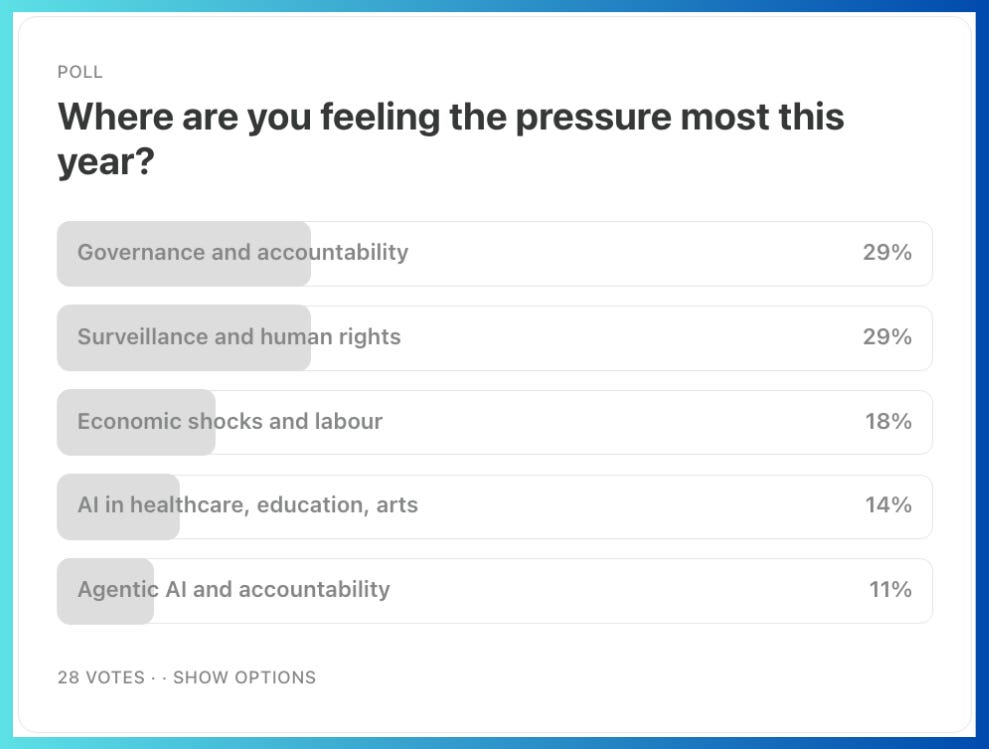
Results From Our Last Poll: Governance and accountability and Surveillance and human rights tied at the top of where the pressure is landing this year. Agentic AI sat at the bottom, for now. An informal read, small sample, but a useful signal.
Recess — How Much AI Is Too Much AI?: From one of Canada’s top schools, a look at what happens when professors leave AI guidelines unclear: the burden of ethical judgment shifts onto students, raising moral stress and competitive pressure.
What Connects These Stories:
FAccT brings the field to Montreal this week around one question: who holds power over an AI system, and who can refuse it? The Vatican asks a version of the same thing, warning against outsourcing moral judgment to machines and concentrating AI power in a few hands. Our readers told us where that pressure is landing hardest, on governance, accountability, and rights. And from a McGill classroom, the Recess piece shows what happens when no one decides at all: the burden of judgment falls to the students with the least say.
The thread is authority. Who holds it over these systems, who can contest it, and who can say no? When authority is concentrated, outsourced, or left unclaimed, the people with the least power absorb the cost.
Those are the questions Volume 8 of the State of AI Ethics Report is built to map, under the frame Power, Fracture, Resistance. The call is open now.

FAccT Comes To Montreal This Year

The ninth ACM Conference on Fairness, Accountability, and Transparency (FAccT) runs from June 25 to 28 at Le Centre Sheraton in Montreal. It is chaired by Su Lin Blodgett of Mila, Robert Soden of the University of Toronto, and Zee Talat of the University of Edinburgh.
We spent the past week with the program. Much of it speaks to the frame we set for this year’s State of AI Ethics Report (SAIER): Power, Fracture, Resistance (Volume 8).
These are the sessions and papers that stood out to us and the threads we’re following. The program is far larger, and we will not have caught everything that matters. Explore the full program, sessions, speakers, and papers here.
Refusal has moved onto the main track:
Alicia DeVrio, Inha Cha, Shira Abramovich, and colleagues run “Visioning Resistance: A CRAFTing Workshop on Adversarial Responses to AI.”
Soizic Pénicaud, Teresa Barrio Traspaderne, and co-organizers present case studies of organized resistance to AI in welfare systems across Colombia, France, India, and Poland.
Yulu Pi, Lucas Lichner, Jae Woo Lee, and co-authors map “Push and Pushback in Contesting AI: Demands for and Resistance to Accountability.”
Cecil Abungu and Elvis Mogesa make the case for moving harm evaluations past procedural box-ticking in “Liberating AI Risk and Harm Evaluations from the Proceduralist Trap.”
Jessica He, Finola Finn, Angel Hsing-Chi Hwang, and co-organizers centre the right to refuse in “Who Bears the Cost of Honesty?”, a session on how AI disclosure rules get written.
Participation shows up as a working method:
Crafting Participatory Tech Futures, a CRAFT session MAIEI helped shape that runs on June 25, asks publics to deliberate and build AI futures grounded in real societal and ecological needs. The Montreal session is the first in a four-part series, continuing in London on July 8 and online on July 20 and 23.
Rashid Mushkani’s “Voices in the Loop: Mapping Participatory AI” surveys who actually gets included.
Iñaki Goñi, Margaret Hughes, and Stuart Lynn present “Connective Democratic Tissue: Second-Order Technologies for Civic Ecosystems.”
Meg Young, Michael Madaio, and Carl DiSalvo offer a sharper read in “You can’t solve democracy in Q3: A Critical Analysis of Corporate Initiatives to Democratize AI.”
Chiara Ullstein, Michel Hohendanner, and co-authors propose PaFRIA, a participatory fundamental rights impact assessment aligned with the EU AI Act, filling a gap the AI Office has yet to address.
Brief #192 covered Canada’s national AI strategy. FAccT examines Canadian governance up close:
A plenary panel, “Canadian AI Policy in a Global Context,” brings together Michael Karlin of Service Canada, technology and human rights lawyer Cynthia Khoo, Cohere’s Joelle Pineau, doctoral researcher Christelle Tessono, and tech critic Paris Marx. Tessono also co-authors “Bureaucratic Silences: What the Canadian AI Register Reveals, Omits, and Obscures.”
A CRAFT session led by Ramaravind Mothilal, Faisal Lalani, and others unpacks the assumptions buried in Canada’s Algorithmic Impact Assessment.
Blair Attard-Frost, Jess Reia, and Ana Brandusescu convene a policy co-design workshop, “Designing AI Policy for and with Trans Communities.”
Power and its capture get named directly:
Abeba Birhane and Zee Talat, who co-chairs the conference this year, are among the authors of “Big AI’s Regulatory Capture: Mapping Industry Interference and Government Complicity.”
Janet Vertesi, danah boyd, Alex Taylor, and Benjamin Shestakofsky present “Reckoning with the Political Economy of AI: Avoiding Decoys in Pursuit of Accountability.”
Sacha Alanoca, Faye-Marie Vassel, and co-organizers build a “FAccT AI Solidarity Lexicon: Counter-narratives for Counter-power,” a community resource for the words that decide what counts as harm.
Shazeda Ahmed, Joshua Kroll, Brian Merchant, and co-organizers ask what an honest research agenda looks like in “Envisioning AI Futures Without AGI.”
Other sessions name harms we have watched arrive in real time:
Roya Pakzad and the Iranian Women’s Coalition for Internet Freedom run “AI Under Internet Shutdown: Evidence and Lessons from Iran,” on AI, censorship, and military operations when a connected population is forced offline, including how safety mechanisms that hold in English break down in Farsi.
Jared Moore, Ashish Mehta, and co-authors study “Characterizing Delusional Spirals through Human-LLM Chat Logs.”
Leah Hope Ajmani, Arka Ghosh, and colleagues document “Seeking Late Night Life Lines: Experiences of Conversational AI Use in Mental Health Crisis.”
Henry Fraser, Jessica Szczuka, and Raffaele Ciriello take up “Regulating Artificial Intimacy: From Locks and Blocks to Relational Accountability.”
AI and Climate Change gets a full plenary, with Tamara Kneese of Partnership on AI, Sasha Luccioni of Sustainable AI Group, Anne Pasek of Trent University, Emma Strubell of Carnegie Mellon University, and Danica Pawlick-Potts of York University.
The keynotes hold the throughline:
Jutta Treviranus of OCAD University opens with “AI Beyond the Tyranny of the Average,” on what prediction does to people whose lives sit outside the dataset.
Charlton McIlwain of NYU speaks from a decade of work on computing, race, and redlining.
Lucy Suchman of Lancaster University brings four decades of critical work on human-machine relations, now focused on AI-enabled warfare.
For us at MAIEI, these threads converge on one question: Who holds power over an AI system, and who can refuse it? That is the terrain Volume 8 of the State of AI Ethics Report is mapping this year, under the frame Power, Fracture, Resistance.
If your work sits here, we’d welcome it in the SAIER. That includes anyone presenting at FAccT we did not name, and anyone working on these questions from outside the conference.
The call is open now and reviewed on a rolling basis. The report puts this work in front of more than 21,000 readers who can act on it, across policy, practice, and community.
Renjie Butalid, Co-Founder of the Montreal AI Ethics Institute and Editor of The AI Ethics Brief, will be at FAccT this year and would be glad to say a quick hello over coffee. Connect on LinkedIn or email him at renjie@montrealethics.ai.
The Pope and the Vatican on AI
On May 15th, Pope Leo XIV published Magnifica humanitas: On Safeguarding the Human Person in the Time of Artificial Intelligence, the Vatican's direct foray into the AI debate. He adopts an overall approach of community-building, desiring a future where AI serves human needs and which recognizes humanity's inherent value as the place where God chooses to dwell. Above all, Pope Leo XIV argues for disarming AI, explicitly rejecting the possibility of a "just war" enabled by algorithms. We must strip technology of its role as a final decision-maker and ultimate moral agent.
The encyclical's thread is blunt: humans must not outsource morality to machines.
It is an argument about the value of human beings and their shared responsibility for AI. Pope Leo XIV explicitly dedicates Chapter 2 to this point, referencing how humans are not to be used as “resources” and not have their value tied to their output. Machines must adapt to human workers and help them work better. The worker should not have to keep pace with the machine. His argument comes in the wake of numerous examples of the instrumentalization of human labour, ranging from voice actors losing control of how their voice is used to content moderators being subjugated to reviewing degrading content.
To prevent these realities from recurring, Pope Leo XIV advocates for generating a shared sense of responsibility and avoiding the concentration of power into the hands of the few. He does not use the word, but we read that as a case for AI sovereignty, as we explored in Brief #186. There is an irony worth naming: a 2,000-year-old institution built on centralized moral authority is the one making the anti-concentration argument. In a period where not only Elon Musk became a trillionaire through SpaceX's IPO, but also where Anthropic customers lost access to the latest Mythos 5 and Fable 5 models due to a direct US government order, AI sovereignty takes on an ideological outlook. Whose values will ultimately prevail in governing AI?
As we have argued at MAIEI since our inception, the answer to this question is community buy-in and collaboration. To create a truly beneficial future that is increasingly influenced by algorithms, AI literacy as a competence and a right is essential. This was our driving force behind SAIER Volume 7: providing a launchpad for policymakers, educators, students, and anyone keen to know more about AI to help co-construct an AI future that represents all it affects.
We determine whether AI helps solve global problems or exacerbates them in the name of progress and benefit to the few. Recognizing our value as humans means recognizing AI is a tool with which to express ourselves, not deny our agency in governing our own path.
A useful companion: The Hugging Face Society & Ethics team has published an annotated reading of the encyclical, with 34 annotations and links to 126 related works (as of publication).
Please share your thoughts with the MAIEI community:
📝 From the Editor
RESULTS FROM OUR LAST POLL
In Brief #192 we asked where the pressure feels most immediate this year. Each option maps to a part of SAIER Volume 8. This was an informal poll with a very small sample, 28 votes, but a good indicator of where things sit.
Governance and accountability and Surveillance and human rights came out on top, tied at 29 percent. No surprise. These are the areas where the gap between stated commitment and structural follow-through is widest right now, and where the consequences are already concrete. They are the ground most of this year's hard cases are being fought on.
Economic shocks and labour landed third at 18 percent, with AI in healthcare, education, arts fourth at 14 percent. What stands out is Agentic AI and accountability at the bottom, 11 percent. That also tracks.
The agentic future is still being marketed faster than it is arriving, and the day-to-day pressure is elsewhere. We would add one caution: a year from now we expect to still be talking about the governance, accountability, and liability of AI agents, and that 11 percent is likely to climb as deployment catches up with the marketing pitch.
SAIER Volume 8 (2026) is now open for contributions. Read the proposed outline, explore the themes, and submit an expression of interest.
💭 Insights & Perspectives:
Recess: For students at one of Canada’s top universities, how much AI is too much AI when guidelines from professors remain unclear?
This piece is part of our Recess series, featuring university students from Encode’s Canadian chapter at McGill University. It examines the absence of clear, consistent AI guidelines in universities and how that vacuum shifts the burden of ethical decision-making onto students, intensifying moral stress and competitive pressure.
To dive deeper, read the full article here.
❤️ Support Our Work

Help us keep The AI Ethics Brief free and accessible for everyone by becoming a paid subscriber on Substack or making a donation at montrealethics.ai/donate. Your support sustains our mission of democratizing AI ethics literacy and honours Abhishek Gupta’s legacy.
For corporate partnerships or larger contributions, please contact us at support@montrealethics.ai
✅ Take Action:
Have an article, research paper, or news item we should feature? Leave us a comment below — we’d love to hear from you!