
The AI Ethics Brief #194: Who Builds, Who Depends, Who Decides
Three new reports show how AI power is concentrating, and why participation has to include the right to refuse.

Welcome to The AI Ethics Brief, a bi-weekly publication by the Montreal AI Ethics Institute. We publish every other Tuesday at 10 AM ET. Follow MAIEI on Bluesky and LinkedIn.
📌 Editor’s Note

In this Edition (TL;DR)
Who Builds, Who Depends, Who Decides: Three reports landed this cycle, from the UN, Stanford, and the OECD. The UN’s first Independent Scientific Panel warns that most countries are “dependent on systems they cannot build, inspect, audit or fully adapt.” Stanford’s AI Index measures the concentration underneath: the US holds the compute, industry produces 90% of frontier models, and responsible AI reporting is not keeping pace. The OECD asks who gets a seat once decisions are made, and cautions that scaling consultation is not the same as deepening it. Together, they set the frame for SAIER Volume 8, Power, Fracture, Resistance, with the call for contributors now extended to July 31.
What FAccT Revealed About Canadian AI Policy: The 9th ACM FAccT met in Montreal from June 25 to 28. A plenary on Canadian AI policy showed a governance system organized around investment, including compute, commercialization, and adoption, while harms, accountability, and oversight remain fragmented, with no dedicated AI regulator. Sovereignty came through less as a national AI stack than as agency: the capacity of people, workers, communities, and nations to decide what gets built, where it is built, and whether it should be built at all.
What Connects These Stories:
Power is concentrating faster than accountability can follow, and the same question runs through every report and every panel: who holds power over an AI system, and who gets to shape it? The evidence base, the compute, and the consultation process are all contested ground. Whether AI serves the public depends on whether people can shape it, limit it, and refuse it.

Who Builds, Who Depends, Who Decides
Three reports came across our desk this cycle, from the UN, Stanford, and the OECD. Read together, they turn on three questions: who builds AI, who depends on it, and who gets to decide.
Here is what each one says, why it matters, and how together they set the stage for the next State of AI Ethics Report (Volume 8), scheduled for release in November 2026.
Note: we have extended the SAIER Volume 8 call for contributors to July 31, 2026. If your work lives in any of these questions, we would like to hear from you.
1. The UN Panel: Building the Evidence Base
What It Says: On July 1, 2026, the Independent International Scientific Panel on AI released its Preliminary Report, the first assessment from a body created by resolution of all 193 UN member states, with 40 researchers across disciplines and regions. Its timing is deliberate. The report arrived days before the UN's first Global Dialogue on AI Governance convened in Geneva on July 6 and 7, the intergovernmental forum created in the same 2025 resolution to carry the Panel's evidence into policy.
The Panel commits to being “balanced,” which it defines as “evaluating empirical data without undue bias towards optimism or pessimism.” It names real benefits. AlphaFold has predicted the structures of more than 200 million proteins now used by over 3 million researchers, and more than a billion people use conversational AI each week. It names concrete harms: AI-generated child sexual abuse material, sycophantic behaviour “linked to several severe mental health incidents, including documented deaths,” and a “gradual erosion of information integrity.”
Two findings sit at the centre. The first is an evidence dilemma: the evidence policymakers need to govern well tends to arrive after the moment to act has passed. The second is concentration. The US holds 75% of the computing power among the world’s top 500 AI supercomputers, a handful of countries control the chip supply chain, and the Panel warns that concentrating AI capability in a few firms and countries “could enable authoritarian capture and undermine democratic accountability.”
Why It Matters: One line carries the report: most member states are “dependent on systems they cannot build, inspect, audit or fully adapt to local context.” That is a sovereignty problem in plain terms. The report is also an argument for its own existence. A shared, public evidence base is a form of resistance to governance set by those who build the systems. The Panel is blunt about the gap that governance has not closed, calling existing instruments “fragmented,” “concentrated among a few corporations,” and noting they “rarely measure real-world effectiveness.” It is also the case Rebecca Finlay, CEO of the Partnership on AI (of which MAIEI is a member), makes in a recent Tech Policy Press op-ed arguing that AI governance cannot belong to a few.
2. The Stanford AI Index 2026: Who Holds the Power
What It Says: Released on April 13, 2026, the AI Index 2026 opens on AI capability: it “is not plateauing. It is accelerating and reaching more people than ever.” Industry produced over 90% of notable frontier models in 2025. On the SWE-bench Verified coding benchmark, performance climbed from 60% to near 100% of the human baseline in a single year. Organizational adoption reached 88%, and four in five university students now use generative AI. Adoption hit 53% of the population within three years, faster than the PC or the internet.
The same report documents the concentration underneath that curve. The US–China model performance gap has effectively closed. The US hosts 5,427 data centres, more than ten times any other country, and a single Taiwanese foundry makes almost all the leading chips. Responsible AI, in the report’s words, “is not keeping pace with AI capability”: benchmark reporting stays spotty even as documented incidents rose to 362, up from 233 in 2024. US private AI investment hit $285.9 billion. The number of AI researchers moving to the US has dropped 89% since 2017. The footprint keeps growing, with data centre power capacity reaching 29.6 GW, comparable to New York state at peak demand.
Why It Matters: We read the AI Index with its provenance in mind. It comes from Stanford's Institute for Human-Centered AI, whose industry ties and capability-forward lens draw caution in some research circles, and its incident count leans on publicly reported cases, so a number like 362 documented incidents, likely understates the real total. On the numbers that matter here, the concentration of models and compute and its environmental and labour costs, the Index is the empirical spine under the UN Panel's warning. When industry produces 90% of frontier models and responsible-AI reporting stays spotty, the people best placed to measure harm are the ones least rewarded for doing so. The report's jagged-frontier finding keeps both hype and doom in check: a model can win IMO gold, while reading an analog clock correctly only 50.1% of the time. The labour effects are already concrete: US software developers ages 22 to 25 saw employment fall nearly 20% from 2024. The costs are landing, as ever, on the people with the least room to absorb them.
3. The OECD on Citizen Participation: Who Gets a Seat
What It Says: Published by the OECD on June 30, 2026, Artificial Intelligence and the Future of Citizen Participation analyzes 50 AI use cases across 22 OECD member and partner countries. It offers a typology of nine ways AI can support participation, among them sense-making, translation, transcription, and facilitation. The report describes what these tools make possible: they can widen participation, lower its cost, and “enable new formats of participation altogether, or at scales not feasible without AI.” It also sets out five categories of risk: ethical risks (skewed data, opacity, misuse that undermines civic space), operational risks (overreliance, hallucination, privacy, cyber threats), exclusion risks (widening digital, language, and societal divides), public resistance risks (eroding trust), and inaction risks (the missed opportunities of not adopting AI where it would help). Governments are already integrating AI into participatory processes at every level of governance, mostly on an ad-hoc or pilot basis, with local governments leading and a growing number of national governments now building coordinated strategies.
Why It Matters: This is the report closest to MAIEI's own theory of change, and the one whose tension we would name most directly. Scaling consultation is a different thing from deepening it, and the two can pull apart. The Canadian federal AI-strategy consultation shows how: submissions from more than 11,300 respondents, sifted in part by AI. Summarizing public input faster only counts as democratizing if people can still say no, to the summary and to the technology. Without that, the tooling launders a decision already made. The report even counts “inaction” as a risk, a framing that treats adoption as the default and refusal as a cost. It is the inevitability the technology's loudest promoters sell, that AI is coming either way and the only question is how fast. We have called out this myth of inevitability before (Brief #187), and the premise does not hold: choosing not to deploy a system, or to deploy a different one, is a legitimate outcome in its own right. Participation without the right to refuse is consultation theatre (Brief #175).
Setting the Stage for SAIER Volume 8
The UN Panel is a fight over who builds the evidence that governance rests on. The AI Index measures how concentrated the compute, capital, and model production already are. The OECD asks who gets to take part once decisions are made, and warns that AI can widen the divides it promises to close.
Power, fracture, resistance. The AI Index names the power. The UN Panel names the fracture, between capability and accountability, and between the countries that build these systems and the ones that depend on them. The OECD points to resistance: the participation, and the refusal, that decide whether any of this serves the public. That is the State of AI Ethics Report (SAIER) 2026 Volume 8 frame, arriving in triplicate.
Together, the three reports set the stage. What they cannot capture is how any of it lands on the ground. That is the work SAIER Volume 8 sets out to do, gathering the stories, the lessons, and the hard-won wins that bring this terrain to life, one account at a time: a clinic running AI triage, a newsroom watching its licensing revenue vanish, a community fighting a data centre, a worker bargaining over the tool that now sets their pace. These accounts are the record, and they matter on three counts. As practitioner lessons: a strategy that worked in one community is something another can adapt for its own. As accountability: they keep the people who bear the cost visible. As agency: they hold on to the proof that the outcome was never inevitable. If these reports set the stage, our contributors are the ones who fill it.
We have extended the call to make room for more of those voices: expressions of interest are now open through July 31, 2026. If your work sits anywhere on this map, we would like to hear from you.
Please share your thoughts with the MAIEI community:
📝 From the Editor
What FAccT Revealed About Canadian AI Policy
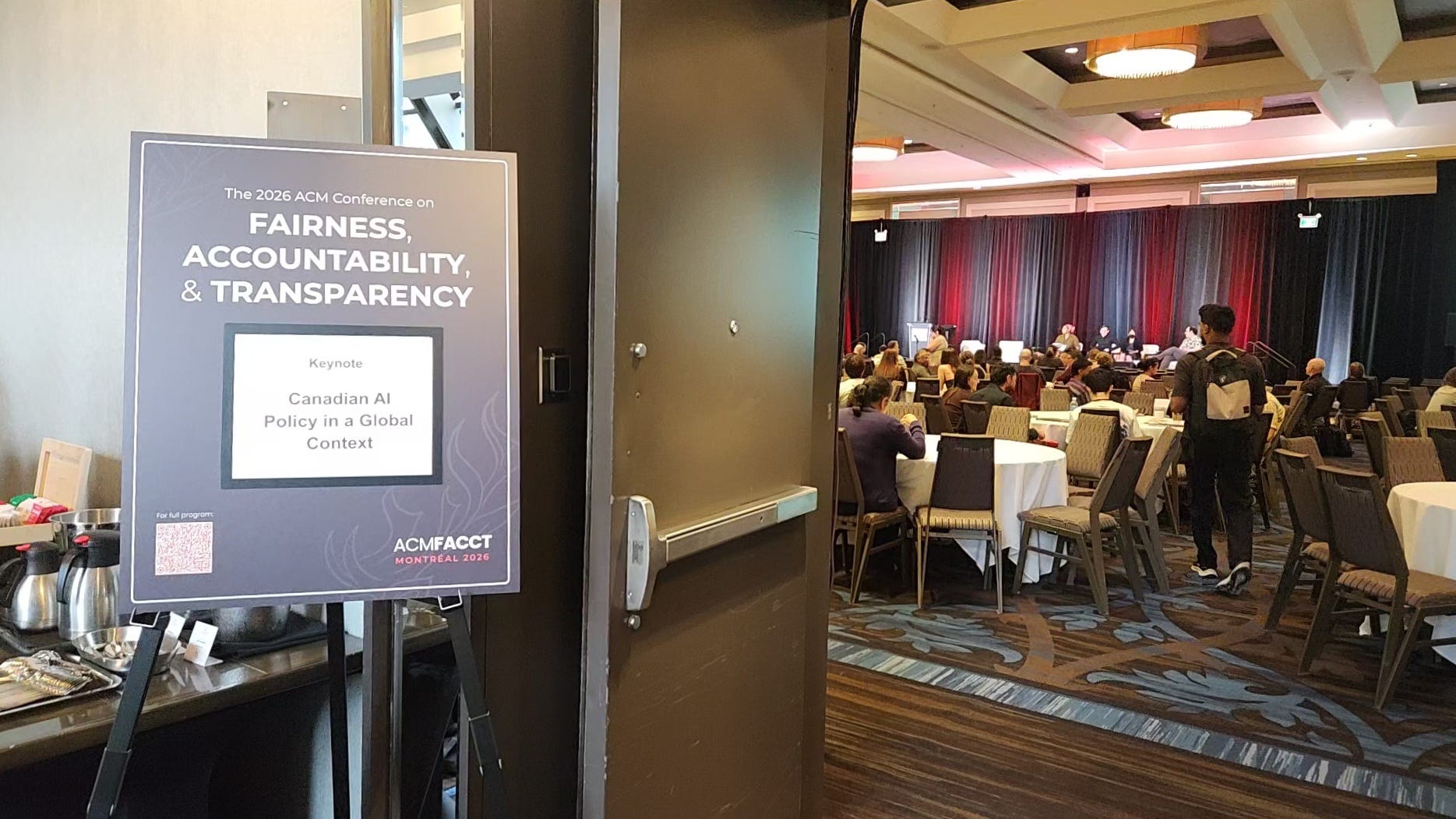
It was a pleasure to have the field gathered in Montreal. FAccT is always too large to take in fully, and this year was no exception. The week moved across plenaries, CRAFT sessions, paper presentations, and hallway conversations that continued long after the formal program ended. Thank you to everyone who shared their work, asked hard questions, and made space for conversations that felt unfinished in the best possible way.
The plenary that mapped most directly onto this year’s SAIER frame was “Canadian AI Policy in a Global Context.” The panel brought together Michael Karlin of Service Canada, Cynthia Khoo, a tech and human rights lawyer, Paris Marx of Tech Won’t Save Us, Joelle Pineau of Cohere and McGill University, and Christelle Tessono of The Dais and University of Toronto. It was billed as a conversation across vantage points, and it gave the room a wide view of where Canadian AI governance stands.
A few takeaways from the panel stood out. Canadian AI governance was described as a system organized heavily around investment: compute, commercialization, research, and adoption. Harms, accountability, and oversight sit in a more fragmented landscape of voluntary codes, public sector instruments, proposed legislation, and no dedicated AI regulator. The panel also returned several times to refusal. Some speakers argued for moratoria and a precautionary posture, because we have already seen what happens when AI systems are rolled out first and governed later. Others questioned whether moratoria can work when the tools are already being used, often through offshore systems and cloud providers.
Sovereignty was another central theme. The strongest account of sovereignty in the room was not simply about building a Canadian AI stack. It was about agency: the capacity of people, workers, communities, and nations to decide what gets built, where it is built, and whether it should be built at all. That point matters in Canada, where data centres, compute infrastructure, and national AI ambitions cannot be separated from Indigenous sovereignty and consent.
The panel also made clear that there is a widening gap between official AI strategy (Brief #192) and public trust. Canada continues to promote AI adoption and infrastructure investment, at the same time that many people are asking for stricter regulation, stronger rights, and more meaningful participation in decisions that affect them. AI literacy framed as “adopt or else” will not close that gap. Participation has to include the power to shape systems, limit them, and refuse them.
For us, the question comes back to the frame of this year’s State of AI Ethics Report: who holds power over an AI system, and who gets to shape it?
There was far more strong work at FAccT than any of us could take in. That is one reason we are looking to bring back our Research Summaries, which have long helped readers keep up with important work across AI ethics, policy, and society.
If you presented at FAccT and would like your paper considered for a future Research Summary, we would love to hear from you at support@montrealethics.ai.
❤️ Support Our Work

Help us keep The AI Ethics Brief free and accessible for everyone by becoming a paid subscriber on Substack or making a donation at montrealethics.ai/donate. Your support sustains our mission of democratizing AI ethics literacy and honours Abhishek Gupta’s legacy.
For corporate partnerships or larger contributions, please contact us at support@montrealethics.ai
✅ Take Action:
Have an article, research paper, or news item we should feature? Leave us a comment below — we’d love to hear from you!
One thread that feels especially important here is the role of public participation — not just scaled consultation, but meaningful civic agency. The OECD section gestures toward this with the distinction between participation and the right to refuse. It seems increasingly important that governance structures include space for ordinary people, communities, and civic institutions to shape how AI is deployed, rather than leaving these decisions solely to policy and technical actors. Otherwise, concentration of power becomes concentration of voice.